Summary: The top dental clinic review platforms in the United States include Google Business Profile, Yelp, Healthgrades, Zocdoc, and Vitals. Google is essential for local search ranking, while Yelp provides detailed patient experiences. Healthgrades is crucial for specialists due to its healthcare-specific focus. Zocdoc combines reviews with booking capabilities, and Vitals offers a large database of patient-submitted reviews.
The advice every dental marketing blog gives is the same: get more Google reviews, because Google is where patients look. That part is true, but it leaves out a lot.
Dentaly's 2023 survey of 1,099 Americans found that many people who use reviews to judge dentists named Google as their most-used platform, while others pointed to Yelp and Healthgrades. A practice that watches only Google can miss what people are reading elsewhere about the same office. Google is not the problem. The other platforms do different work, and skipping them leaves a hole in the picture a patient builds before booking.
This article ranks the six platforms where U.S. dental patients actually read reviews, in the order that reflects how many patients check each one and what each one does for a practice's visibility beyond its own page. The list is not a software comparison. It maps where the review signal lives, so a practice can decide which profiles need accurate details, which ones deserve active attention, and which ones can simply be watched.
1. Google Business Profile: the platform that also ranks you
Google Business Profile is the only review platform whose rating Google documents as an input to local search ranking, which makes it the one profile a dental practice cannot skip. Birdeye's State of Online Reviews 2025 found that Google is a major platform for online reviews, with its share increasing from the prior year. That concentration means the star rating, review count, and recent reviews on a practice's Google profile are the first thing a patient sees when they search "dentist near me," and they are the signal that decides whether the practice appears in the Local Pack at all.
Google's own guidance is to ask customers for reviews with a direct link or QR code, with no incentives and no filtering of who gets asked [https://morebookedchairs.com/blog/dental-review-sites/]. The platform will not remove a review just because it is negative, so the practical move is to reply to every review, including the bad ones, within 48 hours. A practice with strong, recent Google reviews consistently outranks one with a better website but a thin review profile, according to WiserReview's 2026 ranking of dental review sites [https://wiserreview.com/blog/dental-review-sites/].
The exception that changes the strategy: if a practice is a dental specialist, an oral surgeon, or an orthodontist, Google alone is not enough. Patients looking into specialty care tend to go straight to healthcare directories, which is why the next two platforms on this list matter more for specialists than for general dentists.
2. Yelp: where patients read the full story
Yelp is a review site lots of dental patients check, so whatever sits on a practice's Yelp page tends to get seen. As of March 2025, Yelp reported more than 308 million reviews and 29 million unique devices on the app [https://agencyanalytics.com/blog/yelp-analytics-to-track]. RepuGen's 2026 overview of dentist review sites says dentists and dental practices rank among the platform's most reviewed categories [https://www.repugen.com/blog/dentist-review-sites].
What separates Yelp from Google is how much room a patient gets to tell the whole story. Patients on Yelp read about the visit itself, the staff's response to a complaint, and the way problems were handled, according to a quote from Dr. Vidya Colospate of McLean Healthy Smiles in RepuGen's article [https://www.repugen.com/blog/dentist-review-sites]. That makes the reply to a bad review matter almost as much as the review. A calm, specific answer that deals with the complaint without confirming the commenter is a patient tells future patients how the office handles trouble.
Yelp also tells businesses not to ask customers for reviews at all [https://seolyf.com/how-many-review-platforms-dental-practice-needs/]. So a practice cannot run the same review-request process there that it runs on Google. The practical move is simple: keep the listing accurate, add photos, and answer every review with the same generic reply pattern used everywhere, without ever sending a patient to Yelp with a scripted ask.
3. Healthgrades: the healthcare-specific profile that reads like an operations report
Healthgrades draws over 30 million monthly users, and most of them are looking for healthcare providers rather than restaurants or retail, so the traffic has more intent than general review sites [https://wiserreview.com/blog/dental-review-sites/]. A 2020 study in the Journal of Medical Internet Research reviewed Healthgrades ratings for 204,751 U.S. dentists and found that higher scores lined up with shorter patient wait times [https://morebookedchairs.com/blog/dental-review-sites/]. The complaints patients post, from painful procedures to high-pressure sales, read like an operations report on a practice, which is why a dental specialist should treat Healthgrades as a high-priority profile.
The site shows credentials, education, hospital affiliations, and patient ratings side by side, which helps it win trust from patients who want verified professional information instead of star ratings alone [https://wiserreview.com/blog/dental-review-sites/]. Healthgrades pulls data from the National Provider Identifier Registry, a government directory of all active providers, along with patient surveys and claims data [https://rater8.com/blog/top-doctor-review-sites/]. Providers can claim and edit their profiles, but they cannot reply individually to lowly-rated surveys, so volume becomes the main lever: a steady stream of new positive reviews reduces the weight of any single negative one [https://rater8.com/blog/top-doctor-review-sites/]. For a general dentist, Healthgrades works best as a keep-it-accurate profile, with correct hours, correct contact details, and insurance information, plus generic replies on a monthly cadence rather than a daily one [https://morebookedchairs.com/blog/dental-review-sites/]. For an oral surgeon or periodontist, it is a primary discovery channel where patients researching specialty care go directly.
4. Zocdoc: the platform where reviews and booking are the same step
Zocdoc is where patients go to book appointments, and it goes beyond a review site because patients can see availability in real time and book right away, according to Chatmeter's 2025 ranking of dental review directories [https://www.chatmeter.com/resource/blog/reviews-for-dentists-directories/]. The platform has over 6 million patients using its service and more than 50,000 healthcare providers listed, according to RepuGen's 2026 overview [https://www.repugen.com/blog/dentist-review-sites]. Each provider profile shows verified user reviews, accepted insurance plans, and live appointment slots, and patients can compare those details and book through the website or mobile app [https://leafsnap.com/zocdoc-assessing-provider-coverage-filters-and-user-experience/].
The platform charges providers a fee for each new patient booking, and a case study from Zocdoc's own LinkedIn page describes a dental group that saw significant growth in new patient acquisition after working with the platform. For a practice that is already full and not looking for more patients, Zocdoc sits lower on the list. For a practice with open chairs and a need to fill them, the verified review signal and the booking function make it the place where reputation and revenue meet in one transaction.
5. Vitals: the largest patient-submitted review database for dentists
Vitals has 353,705 dentists from all 50 states, with 570,957 reviews from real patients, according to the platform's own dentistry page [https://www.vitals.com/dentistry]. That is the largest dedicated dental review database in the United States, and it is free for consumers to use. Vitals obtains information from a wide variety of sources, including medical boards from all 50 states, federal websites, hospitals, and third-party affiliates, according to ReviewTrackers' overview of doctor review sites [https://www.reviewtrackers.com/blog/doctor-review-sites/].
The review structure on Vitals is more granular than a single star rating. Patients can review several aspects of care using a 5-star ranking system, including whether the dentist spends time with them, whether they receive an accurate diagnosis, whether the staff is friendly, how promptly they are seen, and whether they receive appropriate follow-up after the visit, according to Podium's guide to Vitals reviews [https://www.podium.com/article/vitals-reviews]. Providers cannot delete or alter reviews independently; reviews can only be deleted or changed following an internal assessment by Vitals' customer service team [https://www.vitals.com/dentistry]. The platform is a solid second-tier profile for a general dentist: claim it, keep the information current, and let the review structure do the work of telling a patient what the visit was like without the practice having to write a single word.
6. Clinic Reviews: the cross-platform comparison layer
Clinic Reviews is a search platform that lets people browse verified patient reviews and ratings for U.S. clinics, filtering by city and medical specialty. The site currently indexes over 67,000 rated clinics, covering everything from primary care and pediatrics to cardiology and diagnostic imaging. Each clinic listing shows an overall star rating, review counts pulled from multiple platforms, and short summaries of what patients tend to praise or criticize. It is built to help people compare and choose the highest-rated care near them before booking an appointment.
The value of a cross-platform aggregator is that it removes the need to check each platform individually. A patient who is comparing three dental practices in the same city can see the star rating, review count, and summary of common praise and criticism for each one on a single page, filtered by the specific specialty they need. For a practice, the implication is that its reputation on Google, Yelp, and Healthgrades is not just a collection of separate profiles; it is a composite that an aggregator like Clinic Reviews reads and presents as a single comparison. A practice that has a strong Google profile but a thin or outdated Yelp listing will show up as inconsistent in that composite, and the inconsistency is what a patient notices.
The platform also indexes by state and specialty, which means a practice's visibility in a given city and specialty category depends on how complete and current its data is across the underlying platforms. You can check how a practice appears in the broader comparison by browsing the states directory or the specialties directory on Clinic Reviews. For a practice that wants to understand where it stands relative to competitors in its city, the aggregator view is the fastest way to see the gap without opening six separate tabs.
How to decide which platforms to actively maintain
The decision is not about which platform is best; it is about which platforms a practice's patients actually check, and what each one does for visibility beyond its own page. The table below compares the six platforms on the attributes that matter for a dental practice's decision about where to invest time.
| Platform | Patient usage share | Review volume | Booking feature | Best for |
|---|---|---|---|---|
| Google Business Profile | Varies | Varies | No native booking | Local search ranking |
| Yelp | Varies | 308M+ total reviews | No native booking | Detailed story reviews |
| Healthgrades | Varies | 200M+ patient reviews | No native booking | Specialty care discovery |
| Zocdoc | Not in Dentaly survey | 50,000+ providers listed | Yes, real-time booking | Filling open chairs |
| Vitals | Not in Dentaly survey | 570,957 dental reviews | No native booking | Granular care ratings |
| Clinic Reviews | Not in Dentaly survey | 67,000+ rated clinics | No native booking | Cross-platform comparison |
The usage shares come from Dentaly's survey of Americans. The review volume figures come from each platform's own published data or from the sources cited in the sections above. The booking feature column reflects whether the platform lets a patient schedule an appointment directly on the site.
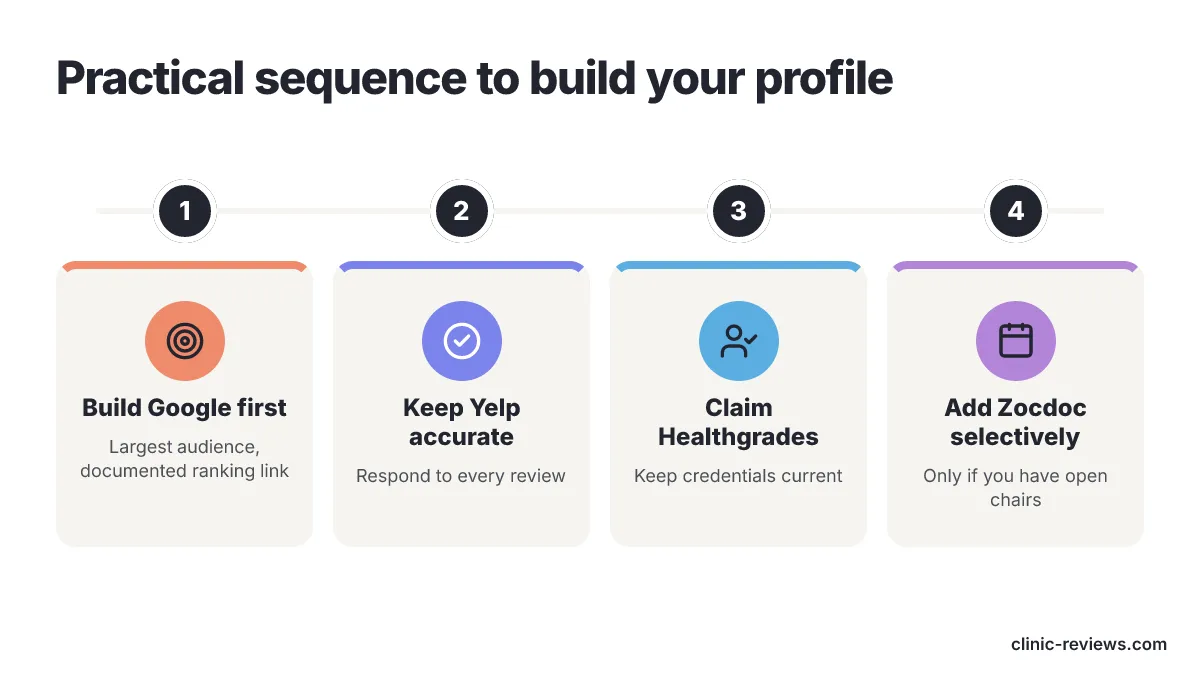
A single-chair or two-location practice rarely needs to actively maintain all six. The practical sequence is: build the Google profile first, because it has the largest audience and the documented ranking link; keep the Yelp listing accurate and respond to reviews; claim the Healthgrades profile and keep credentials current; and add Zocdoc only if the practice has open chairs and is actively seeking new patients. Vitals and Clinic Reviews are lower-effort profiles that benefit from the data already on the other platforms, so they do not require a separate review-generation workflow.
The one rule that changes the strategy for every practice: HHS's Office for Civil Rights has settled with dental practices over replies to online reviews that disclosed patient information. The ADA guidance points the same way: reply generically, never confirm the commenter is a patient, and never mention their care. In an ADA Health Policy Institute survey, many dentists had responded to a review, and some said HIPAA kept them from responding. That is the constraint that applies to every platform on this list, and it is the reason a practice needs a written response template before it starts replying anywhere.
This ranking assumes the practice is a general or specialty dental practice in the United States that is actively seeking new patients through online search. It does not apply to a practice that is fully booked and not marketing for new patients, because the platforms that drive new patient acquisition, Zocdoc and Healthgrades in particular, are less relevant when the chair is already full. It also does not apply to a practice that operates in a market where the dominant review platform is different from the national pattern, which can happen in smaller cities where a local directory or a Facebook group carries more weight than any national platform. The Dentaly survey shares are national averages, and a practice in a rural market may find that Google usage is higher than how its specific patients actually research.
The evidence does not settle which platform produces the highest-quality new patient. Zocdoc's verified reviews and booking function make it the platform where a review is most likely to become an appointment, but the per-booking fee means the cost of that conversion is built into the price. A practice that can fill its chairs through Google and word of mouth may find that the Zocdoc fee is not worth the incremental volume. The decision is a cost-benefit calculation specific to the practice's chair availability and acquisition cost, not a universal ranking.
Where a dental practice should start
Start with the Google Business Profile, because it has the largest audience and the only review signal Google documents as a local ranking input. Claim the Yelp and Healthgrades profiles in the same week, keep the information accurate, and set up a generic reply template that complies with HIPAA before responding to a single review. Add Zocdoc only if the practice has open chairs and is actively seeking new patients. The cross-platform aggregator view on Clinic Reviews is the fastest way to see how the practice's composite reputation compares to competitors in the same city and specialty.
The work is not about getting more reviews on every platform; it is about keeping the profiles accurate, responding to every review within 48 hours, and making sure the composite picture a patient sees across platforms is consistent. That is the baseline, and it is the part that most practices skip.
For practices in Illinois, the 5 top patient review platforms for Illinois dentists breaks down the state-specific landscape. For California practices, the 5 California clinic review platforms to check covers the platforms that matter most in that market. A practice that wants to build the review-generation workflow from scratch can start with the Clinic Reviews Free Patient Review Request Kit, which includes the templates and timing guidance for asking patients without violating platform rules. Wholistic Dental Care [https://wholisticdental.com/] is one of the practices whose reviews appear across these platforms, and its listing is a useful example of how a practice's composite reputation looks when a patient compares it against competitors in the same city.
Frequently Asked Questions
What are the top dental clinic review platforms in the United States?
The top dental clinic review platforms in the United States are Google Business Profile, Yelp, Healthgrades, Zocdoc, and Vitals. Each platform offers unique features, such as Google's impact on local search ranking, Yelp's detailed patient experiences, Healthgrades' healthcare-specific focus, Zocdoc's booking capabilities, and Vitals' extensive database of patient-submitted reviews.
Why is Google Business Profile important for dental clinics?
Google Business Profile is crucial because it influences local search rankings. A dental practice's star rating, review count, and recent reviews on Google are key factors that determine visibility in local search results. Strong Google reviews help a practice appear in the Local Pack, making it essential for attracting new patients.
How does Yelp differ from other dental review platforms?
Yelp differs by allowing patients to provide detailed accounts of their experiences, including how complaints are handled. This platform emphasizes the importance of responding to reviews, as potential patients read about the practice's customer service. Unlike Google, Yelp advises against soliciting reviews, so maintaining an accurate listing and responding to reviews is key.
What makes Healthgrades a priority for dental specialists?
Healthgrades is a priority for dental specialists because it focuses on healthcare-specific information, such as credentials, education, and hospital affiliations. It attracts patients researching specialty care, offering a trusted source for verified professional information. For specialists, it's a primary discovery channel, while general dentists should maintain accurate profiles.
How does Zocdoc integrate reviews with appointment booking?
Zocdoc integrates reviews with appointment booking by allowing patients to see real-time availability and book appointments directly through the platform. It combines verified user reviews with scheduling, making it ideal for practices looking to fill open slots. For practices not seeking new patients, Zocdoc's importance is lower.
Related reading
- 5 Top Patient Review Platforms for Illinois Dentists
- 5 California Clinic Review Platforms to Check
- 2 Best Patient Review Platforms for New York Doctors
- 6 Best Dental Patient Intake Form Examples to Copy
- 6 Best Dental Reactivation Scripts for Front Desk Staff
Sources
- Dental Review Sites: Where a Practice Should Focus | More Booked Chairs
- 11 dental review sites ranked by actual impact (2026)
- See the Best Dentists by state
- Reviews for Dentists: 9 Top Directories Patients Check ...
- Zocdoc Review: Assessing Provider Coverage, Filters, and User Experience - LeafSnap
- What Are the 7 Best Doctor Review Sites in 2026? | rater8