Summary: The best clinic review platforms in California include RepuGen for healthcare review generation, Reputation.com for multi-location review monitoring, ReviewInc for medical practice reputation work, Birdeye for health system-scale review data, and Doctible for patient engagement software context. Each platform serves different needs, from generating reviews to managing patient engagement, and should be chosen based on the specific operational problem a clinic aims to address.
A family looking for medical care in Los Angeles or the Bay Area can run straight into a wall of five-star badges that tell them very little about actual clinical quality.
Across the best clinic review platforms in California, high scores often come from automated texts sent right after checkout, not from smooth intake, attentive nursing, or clear billing. Patients meet empty review pages or testimonials nobody has verified, while office teams try to track feedback scattered across search portals and directories.
To judge clinic review platforms, you have to separate public comparison sites from the internal software medical groups buy for digital reputation work. Public directories help patients compare specialists, read appointment comments, and check office hours before they book care. Enterprise reputation software lives behind the clinic desk. It asks patients for feedback after visits and sends those replies back into ordinary customer support work.
Clinic Reviews deals with that gap directly as a comparison platform where patients can read verified ratings, cross-platform scores, and balanced summaries of healthcare practices around the country. If you understand how practice-side software shapes those public stars, you can read them with more care. Clinic managers get something out of that too, because it helps them choose the right tools for the front office.
1. RepuGen: best for healthcare review generation
Based in Irvine, California, RepuGen focuses on digital reputation tools made only for medical practices and ambulatory centers.
RepuGen healthcare reputation tools gives clinical teams a way to survey patients right after an office visit or outpatient procedure. It does not compete as a public directory where families hunt for a physician. Instead, it sits behind intake and billing work, asks for private patient feedback, and steers satisfied visitors toward public review profiles. RepuGen separates itself from consumer software by staying inside medical spaces. Prospective patients rarely begin their search on RepuGen itself. The reviews they see on search engines often start with automated prompts sent through its messaging sequences. The software sorts responses so unhappy patients get routed to internal resolution forms while satisfied patients get invitations to post public ratings.
Medical groups with busy primary care, physical therapy, or dental clinics tend to get the most value from structured follow-up after a visit. Practice leaders have to keep those messages plain and believable, because savvy patients notice fast when an online profile is only scripted praise pushed out by software.
2. Reputation.com: best for multi-location review monitoring
Operating from San Ramon, California, Reputation.com sells enterprise software built to track, organize, and answer customer reviews across large healthcare networks. Reputation.com customer experience software gives hospital groups, urgent care chains, and regional health systems one place to watch feedback left across dozens of local clinic listings.
Reputation.com stands out because it gives managers oversight across many digital touchpoints.
Patients reading reviews may never see the platform working in the background, but they feel the effects when staff answer public questions quickly, fix conflicting address listings, and update department phone numbers. Organizations with twenty or more satellite clinics gain the visibility they need to spot repeat complaints about parking, check-in delays, or billing disputes across different facilities. A solo medical provider with modest monthly visit numbers will probably not need this enterprise software, and will get more from front-desk phone training and dependable appointment reminder systems.
3. ReviewInc: best for medical practice reputation work
Based in Woodland Hills, California, ReviewInc sells reputation management software built for independent clinics, specialty groups, and dental practices that want steadier growth. ReviewInc medical practice software helps medical managers audit online listings, send patient sentiment surveys, and watch public feedback channels from one interface.
ReviewInc focuses on administrative work, so it is built for practice managers rather than prospective patients searching for a doctor. It also helps clinics build steady post-visit communication habits, and it alerts staff when an upset patient complains about copay calculations or scheduling mix-ups before that frustration spills online.
Independent practices that struggle with uneven review volume can use these workflows to keep recent patient commentary coming at a regular pace.
When patients read these profiles, they should look for replies that show clinical supervisors are checking front-desk bottlenecks and billing errors, not posting generic marketing copy.
4. Birdeye: best for health system-scale review data
Birdeye is headquartered in Palo Alto, California, and it runs an experience and review platform built for enterprise medical operations and hospital networks. Birdeye healthcare experience platform ties patient feedback tracking, business directory upkeep, and digital patient communication into one coordinated system.
Its usefulness shows up at very large scale. A Northern California not-for-profit health system used it across 4,000+ providers and locations to manage reviews, online listings, and wider patient experience data. At that size, automated syncing across clinic sites matters, because operating hours, physician specialties, and facility addresses need to stay correct across search engines. Patients get an indirect benefit when multi-clinic networks keep directory listings accurate and answer local reviews at every facility. Even so, people should still look at reviews for the specific outpatient clinic or specialist they plan to see, since broad health system ratings can hide ongoing problems inside one department.
5. Doctible: best for patient engagement software context
Doctible was founded in 2013 and is based in San Diego, California. It treats review management as part of a wider set of patient engagement and office communication tools. Doctible patient engagement software folds review collection into routine front-desk work, including automated text reminders, two-way patient messaging, digital check-in paperwork, and recall outreach.
Medical offices that want patient communication and review requests inside one system tend to get the most out of it. Other practices may buy separate marketing software, but Doctible is aimed at the office that wants those tasks living together. What people write in online reviews often grows out of administrative contact points: missed reminder messages, confusing intake instructions, or phone calls that nobody answers.
This software fits best when front-desk teams want review requests tied to visit confirmation workflows. Patients comparing clinics on public sites should pay attention to comments about receptionist responsiveness and scheduling clarity, because administrative efficiency shapes patient satisfaction just as much as bedside manner.
How should patients and clinics choose among them?
Patients and clinic administrators face completely different operational decisions when evaluating these platforms. Families seeking dermatology, dental care, mental health support, or family medicine need public comparison directories that present unvarnished patient evaluations across verified appointments. Clinic managers, conversely, must assess internal systems according to the specific front-office bottleneck they intend to solve.
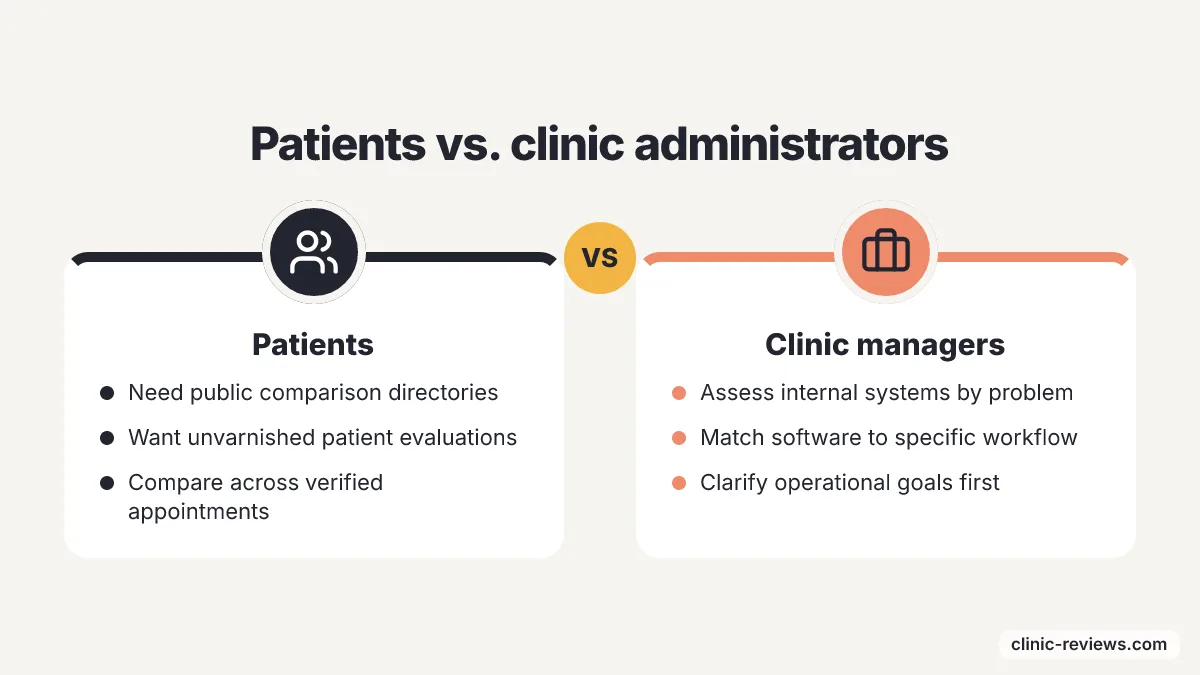
Practice-level software categories must be matched directly to the exact administrative problem clinic leadership needs to solve. RepuGen focuses on generating reviews after patient encounters, Reputation.com monitors multi-location feedback, ReviewInc oversees independent practice reputation profiles, Birdeye manages broad enterprise experience data, and Doctible weaves review requests directly into routine front-desk messaging. Clinic administrators must clarify their operational goals before committing to multi-year software subscriptions.
Public review browsing and appointment scheduling are becoming tightly connected across major search channels. In December 2025, TechTarget reported that Healthgrades partnered with Zocdoc to offer real-time appointment booking directly on provider review pages, projecting more than 16.5 million bookable hours available to patients during the initial rollout window. TechTarget also reported in April 2026 that Yelp introduced an integrated scheduling feature powered by Zocdoc, enabling patients to move directly from provider reviews to booking without navigating away to a third-party website. This direct connection means a clinic profile must present accurate service descriptions and open appointment slots simultaneously.
Stricter platform governance is also transforming how clinics collect and display reviews. Google updated its Business Profile policies in April 2026, officially declaring internal review quotas a violation and barring practices from using staff-name review requests to inflate doctor ratings under its rating manipulation rules. Patients reading provider profiles should treat identical phrases, repetitive compliments naming specific staff members, and sudden clusters of five-star submissions with healthy skepticism. Clinics must adapt by collecting honest feedback through neutral, uncoached survey invitations.
Evaluating outpatient clinics owned by large hospital networks requires examining facility-level quality metrics alongside patient commentary. In May 2026, CMS published an updated QualityNet methodology that analyzed 52 measures across clinical outcomes, safety, and readmissions, rated 3,203 hospitals nationwide, and set a four-star cap for facilities landing in the lowest quartile for patient safety. Patients considering a health-system clinic must evaluate both outpatient office reviews and the affiliated hospital quality rating, particularly when surgical or diagnostic procedures occur on the main campus.
Clinic Reviews serves prospective patients who want this multi-source clarity without navigating proprietary clinic software. The platform aggregates verified ratings, authentic feedback, and cross-channel scores to present an objective profile of local clinical performance.
Dental practices often face an operational logjam rooted in patient intake and scheduling rather than public star ratings. Clincy patient intake coordinator operates as an artificial intelligence intake and reactivation coordinator built specifically for dental offices, collecting patient demographics, medical histories, insurance coverage, and allergy records, writing structured information directly into practice management systems, and reactivating inactive patients who lapsed on follow-ups. Clincy addresses front-office paperwork bottlenecks rather than public review collection, placing it within the practice intake workflow rather than alongside reputation management software.
Solo medical and dental practitioners who cannot reliably pick up front-desk calls, confirm calendar appointments, or explain insurance copays should avoid spending budget on sophisticated reputation dashboards. Small practices in this position must repair their baseline office operations first, after which they can download the Clinic Reviews free patient review request kit to build a compliant, ethical feedback collection process once patients receive consistent care.
Patients should also distinguish between an unreviewed clinical profile and a genuinely problematic track record. A provider with zero posted reviews may have recently relocated, transitioned from academic research, or relied primarily on physician-to-physician referrals, which is why Clinic Reviews explains when doctors with no reviews represent a valid clinical choice versus an active warning sign. The critical factor for patients is checking whether existing reviews address the precise procedure, subspecialty, and insurance questions relevant to their appointment.
Clinics receiving critical feedback must treat negative comments as diagnostic operational data rather than insults to scrub away. A comprehensive analysis by Clinic Reviews outlines whether doctors can delete bad reviews, confirming that healthcare regulations and platform terms usually prevent deleting authentic reviews. The appropriate management response is addressing the patient professionally within privacy standards, rectifying front-office lapses, and inviting regular post-visit feedback from all treated patients.
Conclusion
Begin by addressing the concrete appointment requirements in front of you. Patients evaluating care should cross-reference recent feedback across specific specialties and local clinic branches, confirming whether live online scheduling, hospital network ties, and balanced review histories validate the top-line rating.
Clinic administrators must define their precise administrative problem before signing vendor contracts. RepuGen, Reputation.com, ReviewInc, Birdeye, and Doctible address distinctly different operational functions, spanning post-visit generation, enterprise network monitoring, independent medical workflows, multi-location directories, and front-desk communication. The initial priority is auditing front-office performance, intake phone responsiveness, and patient follow-up procedures before deploying software to capture public feedback.
Frequently Asked Questions
What are the best clinic review platforms in California?
The best clinic review platforms in California include RepuGen, Reputation.com, ReviewInc, Birdeye, and Doctible. Each platform serves different needs, from generating reviews to managing patient engagement, and should be chosen based on the specific operational problem a clinic aims to address.
How does RepuGen help healthcare practices?
RepuGen focuses on digital reputation tools specifically for medical practices. It surveys patients right after visits, steering satisfied patients toward public review profiles while routing dissatisfied patients to internal resolution forms. This helps practices manage their online reputation effectively.
Why would a healthcare network choose Reputation.com?
Reputation.com is ideal for healthcare networks with multiple locations because it provides oversight across many digital touchpoints. It helps manage feedback across various clinic listings, ensuring accurate information and quick responses to public inquiries, which is crucial for large organizations.
What makes ReviewInc suitable for independent clinics?
ReviewInc is designed for independent clinics and specialty groups that want to manage their online reputation. It helps with auditing online listings, sending patient surveys, and monitoring feedback, allowing clinics to maintain steady communication and address patient concerns before they escalate online.
How does Doctible integrate review management with patient engagement?
Doctible integrates review management with patient engagement by combining review collection with front-desk tasks like automated reminders and digital check-ins. This integration helps practices streamline communication and improve patient satisfaction by addressing administrative contact points effectively.
Related reading
- Doctor with No Reviews in New York: Is It a Red Flag?
- Dr Priya Angi Reviews: Effective Management Strategies
- 2 Best Patient Review Platforms for New York Doctors
- Can Doctors Delete Bad Reviews? 2026 Guide for Practices