Summary: For New York doctors, the best patient review platforms are Vitals and Quality Reviews. Vitals is ideal for patients comparing doctors publicly before making a choice, offering a broad view of reputation signals. Quality Reviews excels in collecting real-time feedback from patients after visits, providing detailed insights into specific aspects of the care experience.
Our directory lists 44 clinics in New York as of October 2026, and a patient looking for a specialist can spend an afternoon sorting through stars, review counts, appointment links, and half-finished comments before making a single call. That takes time, yes, but time is only part of it. A polished rating page can still leave a caregiver unsure whether patients are talking about the doctor, the front desk, billing, or the building itself.
The best patient review platform for New York doctors depends on the task at hand. Vitals fits public doctor discovery better, while Quality Reviews matters more when a practice is gathering real-time feedback from its own patients. A high star rating still does not tell the whole story, as many New York listings in our directory have high ratings.
Patient reviews become useful when the platform gives enough context to separate a one-off complaint from a repeated pattern. These two platforms handle that job in different ways. The better choice changes depending on whether you are browsing for care or answering a clinic's request for feedback.
1. Quality Reviews (Q-Reviews): best for real-time practice feedback
Quality Reviews patient engagement platform is a patient engagement platform, and its official company record lists its address as New York, NY. It is used by New York-based practices like Reproductive Medicine Associates of New York to collect feedback from patients in real time. That works best when a doctor's office sends the request soon after the visit, because the comment can still track the appointment while the details are fresh in the patient's head.
Q-Reviews is not the first place a patient would go to browse every doctor in a specialty before booking. Its value shows up inside the practice relationship, where a clinic wants to hear about check-in, wait time, communication, or follow-up without waiting for a public complaint to surface somewhere else. Patients should treat a Q-Reviews prompt as a chance to name the exact part of the visit that worked or failed. A useful response says whether the problem happened at scheduling, arrival, the exam, billing, or aftercare. That kind of detail tells the practice what to fix before the next patient runs into the same problem.
2. Vitals: best for public doctor discovery
Vitals doctor listing platform operates as an online listing platform for finding doctors and other medical care setups. It keeps a location at 632 Broadway #301 in New York, NY, along with its other offices. This platform is the better fit for patients who are still comparing doctors before they decide whom to call. Vitals fits the early search stage because public listing platforms let patients scan doctors across a specialty, compare visible review signals, and decide which profiles deserve a closer look. Patients should read past the top-line rating and look for repeated comments about scheduling access, bedside manner, office communication, and whether the reviewer is describing the same kind of care the patient needs.
Vitals is weaker when a patient wants to understand what a specific practice does with feedback after a visit. Public review pages show reputation signals, but they do not always show whether a clinic tracks private complaints, responds internally, or changes its process after patients report the same issue.
How should a New York patient choose between review platforms?
A New York patient should begin with the fork in the road: use Vitals while comparing doctors, and use Q-Reviews when a practice wants direct feedback after a visit. Those platforms answer different questions, so treating them as if they were the same sets up the wrong expectation before anyone has read a single review.
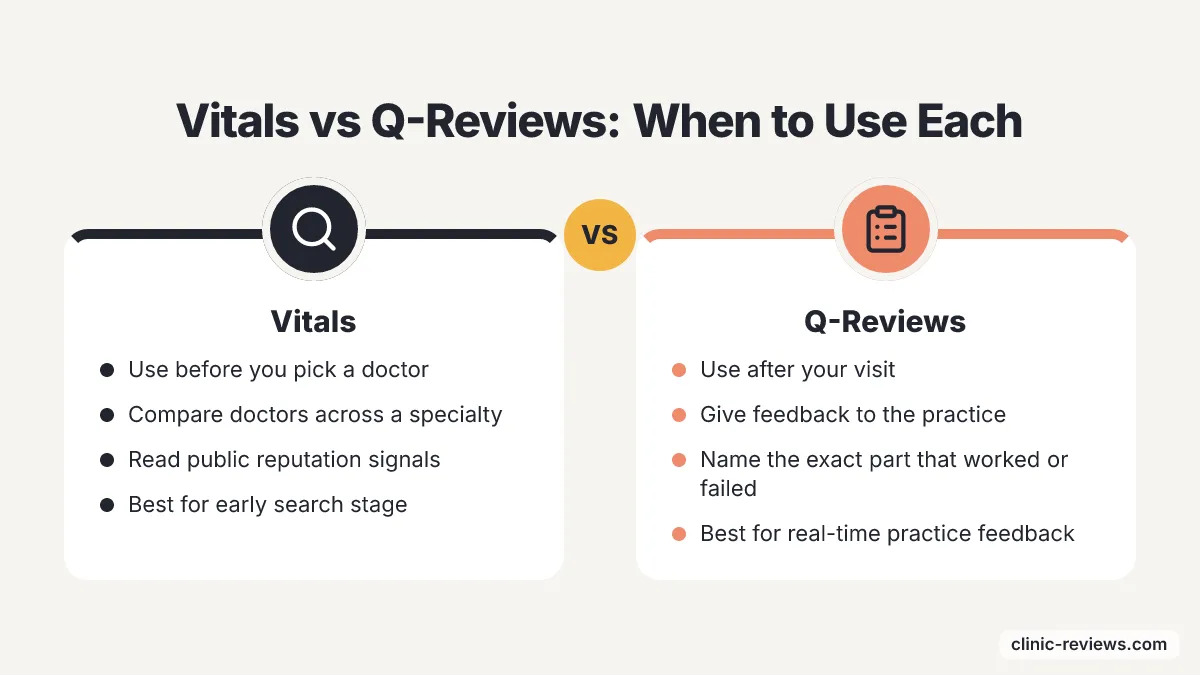
A public listing site works better when the patient has not picked a doctor yet. Its strongest use is for searches like cardiology, dermatology, primary care, or reproductive medicine, where the patient wants to compare visible reputation signals before making a call. The median rated New York listing in our directory has 316 reviews, so half of those 32 rated listings sit below that number. Review count should be part of the read, not just stars.
A practice feedback site fits better after the appointment, when the patient wants the clinic to hear something specific. A note about a long check-in line, a confusing portal message, or a rushed explanation does more work when it reaches the clinic close to the visit. "Good doctor" or "bad office" leaves out the step where the experience changed, and that missing detail matters.
Patients comparing New York doctors should use a short reading routine before booking:
- Read the newest comments first, because staffing, scheduling, and front-desk policies change faster than a doctor's training or specialty.
- Compare the rating with the review count, because a 5.0 rating from a small number of comments sends a different signal than a 4.8 rating from hundreds of reviews.
- Look for repeated details, such as late callbacks, rushed visits, clear explanations, or billing confusion, instead of treating one angry paragraph as the whole record.
- Check whether the comments match the care you need, because a glowing cosmetic visit says little about chronic disease management, surgery follow-up, or a complex diagnosis.
A patient choosing care should also know what changed around review collection. In April 2026, Google updated its Maps policy to bar merchants from requesting staff review quotas and from asking for reviews with specific content that identifies a staff member, according to the Google Maps review policy update. Patients reading ratings that draw from Google-sourced reviews should expect less staff-coached language over time, though older reviews may still reflect past collection habits. Hospital-level patient experience signals can add context when a doctor practices inside a larger system. In May 2026, Healthgrades announced its Outstanding Patient Experience Award winners after evaluating HCAHPS patient survey data across 10 key patient experience measures, according to the Healthgrades 2026 patient experience awards. A hospital award does not prove that one doctor is the right fit, but it gives patients another dated signal to compare with platform reviews.
A patient searching for the top patient review platforms for doctors in Texas should use the same test instead of assuming a different state changes the method. Public discovery still belongs on a public listing platform, and visit-specific feedback still belongs in the channel the practice gives the patient. State matters most for coverage depth and local doctor participation, not for the basic way a patient should read review evidence. A doctor with no public reviews is not automatically a bad choice, but the gap changes what the patient should ask before booking. Clinic Reviews has a fuller discussion of when a doctor with no reviews in New York deserves more caution, especially when the patient cannot find other evidence of access, specialty fit, or patient communication.
Patients should not use review platforms as the deciding tool for emergency symptoms. Chest pain, stroke symptoms, severe allergic reactions, and other urgent warning signs call for immediate medical care rather than reputation comparison, because the safest next step is driven by the symptom, not by a star rating.
Practice owners reading the same review pages have a different job from patients. DDS Collective is the only advisory network in dentistry that bridges independent practice owners directly to startup founders, technology, and vetted talent through one trusted relationship instead of six to ten scattered vendors, and DDS Collective dental advisory ecosystem belongs in that operations discussion rather than in a patient-facing review-platform ranking. A patient choosing a doctor should stay focused on evidence from the visit experience and the doctor's fit for the condition. Patients who want to understand the rules around negative comments should separate moderation from reputation. A clinic may respond to criticism or report content that breaks a platform's rules, but the practical question is whether the pattern in the remaining reviews points to a real access or communication problem. Clinic Reviews explains the practice side of that issue in its article on whether doctors can delete bad reviews, which is useful background when a profile looks unusually clean.
Clinic Reviews is a search platform that lets people browse verified patient reviews and ratings for U.S. Clinics, filtering by city and medical specialty. The useful habit is to compare several review sources, then call the office with one or two concrete questions before booking, because ratings narrow the list but the office's answer still tells you how the next visit may feel.
Conclusion
Start with the platform that matches your next action. Use Vitals when you are still building a shortlist of New York doctors, and take a Q-Reviews request seriously when you have already seen a practice and want your feedback tied to the visit.
The first practical step is to pick one specialty, compare review count and recent comments, then call the office with a question the reviews raised. Ask about appointment availability, follow-up, insurance handling or the service line you actually need. Patient reviews are a screening tool, not a diagnosis of quality, so the work stops when you have enough evidence to make the next call or book the appointment.
Frequently Asked Questions
How should I read patient reviews for doctors?
Patient reviews for doctors are most useful when you look for repeated patterns rather than isolated praise or anger. A comment about a rushed visit matters more if several patients describe the same issue. A high rating with thin detail should prompt a follow-up question to the office, especially when the appointment involves ongoing care, a procedure or a condition that needs coordination.
Is a doctor with no reviews in New York a warning sign?
A doctor with no reviews in New York is a reason to ask more questions, not a reason to rule the doctor out automatically. Newer doctors, specialists with referral-heavy practices and clinicians inside larger systems may have fewer public comments. Before booking, ask about the doctor's experience with your condition, appointment timing and how follow-up questions are handled.
Related reading
- Dr Priya Angi Reviews: Effective Management Strategies
- Doctor with No Reviews in New York: Is It a Red Flag?
- Can Doctors Delete Bad Reviews? 2026 Guide for Practices
- Dr. Keishia Mackie Reviews: Clinic Impact in 2026
- Clinic Marketing Platforms: Pick by Price and Fit