Summary: Colorado offers a wide range of addiction treatment centers, with 827 clinics across 263 cities. Notable centers include CeDAR in Aurora for virtual outpatient options, Peaks Recovery in Colorado Springs for location convenience, and Continuum Recovery in Denver for accredited outpatient care. Foundry Front Range in Broomfield provides medically supervised detox, while Flatirons Recovery in Boulder offers evidence-based holistic care. Choosing the right center depends on the level of care needed and specific patient requirements.
The intake coordinator says a bed is open, then asks whether detox, residential care, or outpatient treatment is the right match. The person making the call now has to sort through safety, location, insurance questions, and the program's level of care before anyone has slept well. Colorado has enough recovery choices that a star rating by itself is a thin filter. Our directory includes numerous Addiction Treatment clinics across various cities, and many of the listings have high ratings.
The practical position is simple. Choose the care level first, then use location, accreditation, virtual access, and patient-review patterns to narrow the list. The six Colorado recovery and addiction treatment centers below do different jobs, so the useful question is not which name sounds best, but which setting fits the next step in care.
1. CeDAR, Center for Dependency, Addiction and Rehabilitation: best for a healing setting with virtual outpatient options
CeDAR, Center for Dependency, Addiction and Rehabilitation offers a safe, professional, healing setting in Aurora, Colorado, and it also offers virtual outpatient options. That pairing works for a patient or caregiver who wants an established in-person treatment site, while still needing to ask whether outpatient care can continue without repeated travel. CeDAR belongs near the top of a comparison list when the caller is not only asking, "Is there treatment?" but also asking how care continues after the first appointment. Virtual outpatient availability matters for families juggling work, school, or caregiving duties, because the next hurdle after admission is showing up again and again.
A useful first call to CeDAR should ask which services require an in-person visit, which outpatient appointments are available virtually, and how the center decides whether a patient belongs in outpatient care. Those answers matter more than a broad promise of recovery, because the wrong level of care burns time during a period when follow-through is already hard.
2. Peaks Recovery Centers: best for a clearly identified Colorado Springs location
Peaks Recovery Centers is located at 1755 Old Ranch Rd, Colorado Springs, CO 80908. That published address gives patients and caregivers a concrete starting point when travel time, family visits, and transportation are part of the treatment decision.
Peaks Recovery Centers is worth comparing when Colorado Springs access is part of the care plan. A center near the patient's support system may make family coordination easier. A center farther from daily triggers may suit someone who needs distance from a familiar environment.
A first call to Peaks Recovery Centers should confirm the program setting, the admission process, and how family communication works after intake. Public location information gets the search started, but the admission conversation should establish whether the center's services match detox, residential, outpatient, or continuing-care needs before a family weighs review scores.
3. Continuum Recovery Center of Colorado: best for accredited outpatient treatment in Denver
Continuum Recovery Center of Colorado is a Joint Commission accredited outpatient addiction treatment center in Denver, CO. That makes it a strong comparison point for patients who need outpatient addiction treatment and want to ask about an external accreditation standard during the selection process.
Continuum Recovery Center of Colorado fits a patient who is not looking for a residential bed but still needs structured addiction treatment. Outpatient care works only when the patient can attend sessions, stay safe between visits and manage the daily routines that treatment does not remove.
A first call to Continuum Recovery Center of Colorado should ask what outpatient schedule is required, how the program handles relapse risk between appointments and whether insurance coverage applies to the recommended level of care. Accreditation is a meaningful signal, but it does not replace the practical question of whether the patient can actually attend the program often enough for it to work.
4. CuraWest, Guardian Recovery: best for checking a Denver option by address before admission
CuraWest, Guardian Recovery is located at 2535 South Downing St Ste 500, Denver, Colorado 80210. The public address makes CuraWest a relevant Denver option to verify when a patient or caregiver is building a short list and needs to confirm program details directly.
CuraWest should be approached as a call-first option because the supplied public fact is location rather than a full description of treatment level. The named exception to comparing centers by level of care first is a listing that does not publicly state enough service detail in the material you have, because silence on a web page should not be treated as proof that a program lacks or offers a service.
A first call to CuraWest should ask what levels of care are available at the Denver address, what clinical screening happens before admission and what the center recommends if the patient needs a different setting. A location can belong on a short list, but the program match has to be confirmed before the family uses reviews to decide.
5. Foundry Front Range: best for medically supervised detox and residential treatment
Foundry Front Range provides medically supervised detox and residential addiction treatment in Broomfield, Colorado. That public description makes Foundry Front Range the clearest match on this list for someone comparing options that include both detox and residential care.
Foundry Front Range is especially relevant when the immediate question is whether the patient needs a supervised setting rather than appointments spread across the week. Medically supervised detox and residential treatment point to a more intensive care environment than outpatient treatment, so the caller should be ready to discuss current substance use, safety concerns and prior withdrawal experiences.
A first call to Foundry Front Range should ask how detox admission is evaluated, how residential treatment follows detox and what information the center needs before intake. Those answers help a caregiver avoid a common mistake: choosing a program because it is well reviewed, then discovering that the setting does not match the patient's current clinical risk.
6. Flatirons Recovery: best for evidence-based and holistic care in Boulder
Flatirons Recovery in Boulder provides evidence-based, holistic mental health and addiction treatment in Boulder, Colorado. That positioning suits a patient who wants addiction care considered alongside mental health needs rather than treated as a completely separate problem.
Flatirons Recovery belongs on a shortlist when a patient or caregiver is asking about both clinical methods and whole-person support. "Evidence-based" and "holistic" are terms worth unpacking on the phone, because a useful admissions conversation should translate them into actual services, schedules and clinician involvement.
A first call to Flatirons Recovery should ask which evidence-based therapies are used, how mental health care is coordinated with addiction treatment and what the program expects from family participation. The best fit is not the center with the broadest language, but the center that can explain how its model applies to the patient's diagnosis, substance use history and ability to attend care.
How to choose among Colorado recovery centers
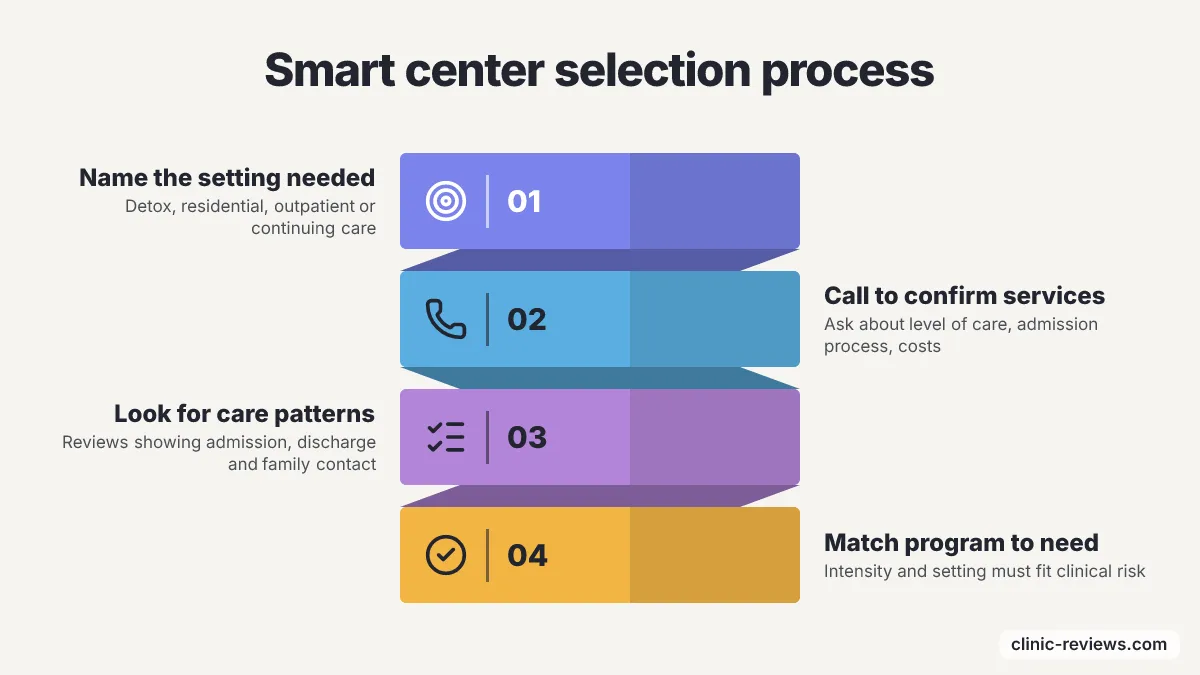
Start by naming the setting the patient likely needs: medically supervised detox, residential treatment, outpatient treatment or continuing care after discharge. A review page is useful after that point, but reading ratings before identifying the level of care turns the search into a popularity contest between programs built for different situations.
How Colorado Medicaid and public funding changes affect the choice
Colorado policy changes make the payment conversation more important for Medicaid patients and families. Colorado HCPF said in June 2026 that the Centers for Medicare and Medicaid Services approved a 90-day SUD waiver extension, extending Colorado's Expanding the Substance Use Disorder Continuum of Care approval period through December 31, 2026.
Peer support coverage also deserves a direct question during intake. Colorado HCPF published a final policy in May 2026 clarifying the scope of peer recovery groups for services facilitated by Behavioral Health Peer Support Professionals in group settings under Health First Colorado, which affects what Medicaid patients can get covered.
Public funding is another signal that Colorado's recovery system is changing around patients, not only inside private treatment centers. Colorado Attorney General Phil Weiser announced in July 2026 that opioid settlement funds would provide $12 million in grants to 27 organizations for youth treatment, recovery, rural and underserved behavioral health work and peer workforce support.
Naloxone access belongs in the family safety plan even when a patient is entering treatment. Colorado Attorney General Phil Weiser announced in October 2026 an additional $3.5 million naloxone investment from opioid settlement funds, bringing the total to $6.5 million to sustain statewide access through June 2028.
How to read patient reviews of Colorado treatment centers
Use reviews to test fit, not to outsource the decision. In our directory, the median rated Addiction Treatment listing carries 49 reviews, so half of those 702 rated listings sit below that review count and may give a thinner picture of patient experience.
A good review check looks for patterns in the same concerns the patient will face: admission communication, staff responsiveness, discharge planning, family contact and whether the center explained costs before treatment began. A high rating with few details is less useful than a mixed review profile that repeatedly explains what the program does well and where patients felt surprised.
Clinic Reviews is a search platform that lets people browse verified patient reviews and ratings for U.S. clinics by city and medical specialty. The site's verified clinic review platform is built for comparison, so use it to narrow options, then call the treatment center to confirm services, insurance and admission timing.
Specialty context matters when reading ratings across healthcare. A family comparing unrelated care, such as preventive, restorative and cosmetic dental services for all ages, should use different signals than a family comparing addiction treatment centers, and Canyon Ridge Dental is a small South Ogden, Utah-based dental practice rather than a Colorado recovery provider.
A practical call script is better than a vague request for availability. Ask:
- Which level of care would your clinical team screen for first?
- What information do you need today?
- What costs or coverage questions should be answered before admission?
- What happens if your program is not the right setting?
The cheaper or faster option is sometimes the right option when the patient is stable, the recommended setting is outpatient and the program can explain attendance expectations clearly. The more intensive option is worth prioritizing when the center's stated services match detox or residential needs, because convenience does not offset a mismatch in clinical setting.
Which Colorado recovery center to call first
Begin with one call that clarifies level of care, not with a debate over which center has the best name recognition. Ask the admissions team whether the patient is being screened for detox, residential treatment, outpatient care or continuing support, then compare only the centers that actually match that answer.
Colorado patients and caregivers have more to verify than a rating: address, setting, accreditation, virtual access, Medicaid coverage and naloxone planning all change the decision. Reviews should sharpen the shortlist after those facts are known. The advice stops at selection: a treatment center's clinical team, insurer and, when needed, emergency care are the places to decide medical safety and timing.
When to seek urgent care instead of waiting for admission
Comparing treatment centers is for planning, not for emergencies. If someone may be overdosing, is unresponsive, has slowed or stopped breathing, or is having severe withdrawal symptoms such as seizures, confusion or hallucinations, call emergency services right away and use naloxone if it is available. Do not wait for an intake call or an open bed before getting emergency care.
Frequently Asked Questions
What are the best addiction treatment centers in Colorado?
Six notable addiction treatment centers in Colorado are worth comparing: CeDAR in Aurora, Peaks Recovery in Colorado Springs, Continuum Recovery in Denver, CuraWest in Denver, Foundry Front Range in Broomfield, and Flatirons Recovery in Boulder. Each center offers different services, such as virtual outpatient options, medically supervised detox, and evidence-based holistic care.
How do I choose the right addiction treatment center in Colorado?
Choosing the right center depends on the level of care needed, such as detox, residential, or outpatient treatment. Consider factors like location, accreditation, virtual access, and patient reviews. It's important to match the center's services with the patient's specific needs and circumstances.
What services does CeDAR in Aurora offer?
CeDAR in Aurora provides a healing setting with virtual outpatient options. It is suitable for patients who need an established in-person treatment site but also require the flexibility of virtual outpatient care. This is beneficial for families juggling work, school, or caregiving duties.
What makes Peaks Recovery Centers in Colorado Springs a good choice?
Peaks Recovery Centers is located in Colorado Springs, offering a convenient location for patients who need to consider travel time and family visits. It is a good choice for those who want a center near their support system or need distance from daily triggers.
What type of care does Foundry Front Range in Broomfield provide?
Foundry Front Range offers medically supervised detox and residential addiction treatment. It is ideal for patients who need a supervised setting rather than outpatient appointments, providing a more intensive care environment for those with higher clinical risk.
Which Colorado centers on this list offer outpatient or virtual care?
Continuum Recovery Center of Colorado in Denver is a Joint Commission accredited outpatient addiction treatment center, and CeDAR in Aurora offers virtual outpatient options. Outpatient care fits a patient who can attend sessions and stay safe between visits.
Does Health First Colorado (Medicaid) cover addiction treatment?
Colorado's Medicaid program, Health First Colorado, covers substance use disorder care under a waiver that federal regulators recently extended, and Colorado HCPF has clarified coverage for peer recovery groups. Ask each center during intake whether it accepts Health First Colorado for the recommended level of care.
What should I ask on the first call to a treatment center?
Ask which level of care the clinical team would screen for first, what information it needs today, what costs or coverage questions should be answered before admission, and what happens if the program is not the right setting.