Summary: The best care clinics in California to study include UCLA Health for its extensive reach, Cedars-Sinai for its tertiary hospital positioning, Stanford Health Care for its specialty pathways, Scripps Health for its access across care settings, and Kaiser Permanente Los Angeles Medical Center for its department visibility. These clinics serve as benchmarks for clinic owners to improve access, referrals, and patient communication.
A clinic director who checks regional competitors usually begins by searching for the best care clinics in California. The goal is to copy the site layout, the booking path, and the intake forms used by market leaders. That instinct breaks down fast. California's top healthcare groups work because of structural facts an independent practice does not have, such as university research support, huge nonprofit balance sheets, broad hospital networks, and specialty departments tied together under one roof.
Using the best care clinics in California as if they were operating manuals creates a mess for private offices and regional groups. A dental group looking for the best dental clinics in California gets little value from copying a multi-layer hospital intake process that annoys patients who only want a routine cleaning. Clinic operators get more from treating these large health networks as benchmarks. They show where local scheduling gets clogged, where referrals leak away, where service descriptions blur, and where communication falls apart.
Five California care clinics worth benchmarking
People looking for care still turn to directories when they compare medical providers. On Clinic Reviews, consumers review verified patient reviews and ratings across outpatient practices nationwide. Those profiles are useful because they show how top organizations explain their care levels, present doctor credentials, and route incoming traffic before anyone books a visit.
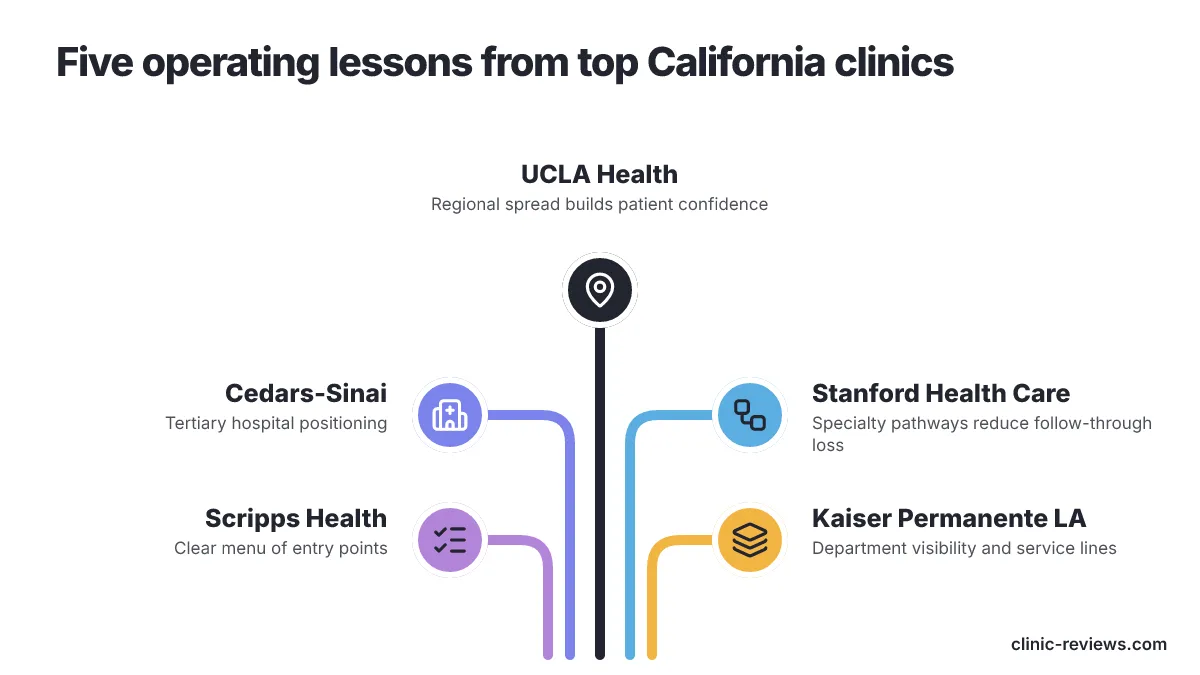
To read them well, you have to look past brand shine and watch the mechanics underneath: patient routing, communication rules, and clinical boundaries. Each of the five institutions below handles a different operating problem. Community practices can borrow the lesson without piling on more administrative work.
1. UCLA Health: best for Southern California reach
Practice leaders who want to see how regional spread builds patient confidence can look at UCLA Health hospitals and clinics as a reference point. The academic system says it ranks as one of America's top hospitals and provides treatment across 5 hospitals and more than 290 locations spread through Southern California. Patients see many neighborhood access points, and those points feed back into one clinical institution.
Wide regional coverage needs hard limits on what care a clinic will take on. Smaller practices need that discipline too, even without university backing. An academic network can move cases between outpatient doctors and tertiary hospital floors with relative ease. An independent practice has to spell out which conditions it will not treat and where those patients should go next. That kind of transparency now carries legal weight under recent state oversight. Governor Newsom signed statutes in September 2026 covering clinical technology, and the official details tied to California AI healthcare laws say licensed clinicians must keep final authority over medical decisions when algorithmic systems help with care.
2. Cedars-Sinai: best for tertiary hospital positioning
A clinical brand can center itself on acute capability instead of quick convenience, and Cedars-Sinai full-service hospital does that clearly. Cedars-Sinai operates in Los Angeles as an acute tertiary facility. Its public identity is built around the largest nonprofit hospital in the West, with advanced surgery and inpatient care doing much of the work.
Clinic operators should separate tertiary credibility from broad marketing copy by naming the clinical complexity of their own services on every public channel. Patients need plain guidance about whether an outpatient site focuses on preventive maintenance, complex specialty consults, or urgent procedures. That kind of clinical ownership lines up with the regulatory shifts described by The Cooperative of American Physicians in January 2026. Their report said California SB 351 limited non-physician corporate influence over clinical workflows by setting up SB 351 physician control rules. Those rules point to the same conclusion: patient trust depends on clear, provider-led medical standards, not outside corporate management.
3. Stanford Health Care: best for specialty pathways
Outpatient clinics that are losing patient follow-through can study how Stanford Health Care primary offices build a continuous care route. The group connects neighborhood primary care sites across the Bay Area straight to regional campuses such as the Redwood City and Palo Alto clinics and subspecialty destinations like the Stanford South Bay Cancer Center. That gives patients a clear line from diagnosis to advanced treatment.
Independent medical and dental centers often lose patients after referral because the next step is hidden or messy. A private practice does not need a giant university system to reduce that loss. It can list the specialists it works with, spell out which symptoms belong in primary care, and say when an outside referral makes sense. Patient handoff also has a compliance side. An October 2026 legal analysis from Holland & Knight notes that California AB 1609 took effect after its September 2026 passage. The rule curbs automated chat tools that pose as staff and requires direct paths to live representatives, while leaving room for specific hospital workflows under AB 1609 chatbot rules. Digital scheduling tools still need a real front desk behind them.
4. Scripps Health: best for access across care settings
A clear menu of entry points, without confusing new patients, is on display across Scripps Health care sites. The San Diego health system organizes its provider network across different settings, with medical staff across hospitals, walk-in clinics and telehealth as well as outpatient offices, specialized surgery suites, and full emergency departments.
Community practices can borrow that clarity by removing guesswork about where common problems belong. Patients get stuck choosing between a virtual visit, an urgent care slot, or a hospital emergency room. The practice that explains triage rules first wins trust before intake starts. Keeping walk-in hours open takes financial discipline too. A July 2026 report in the Journal of Urgent Care Medicine found that California urgent care centers tied to community or rural health centers saw minimum wages rise from $21 to $22 per hour, while most other urgent care operators moved from $21 to $23 under urgent care wage rules. Longer walk-in hours and extra clinic shifts need a payroll plan that matches the schedule.
5. Kaiser Permanente Los Angeles Medical Center: best for department visibility
A large medical campus needs fast structural clarity, and Kaiser Permanente Los Angeles Medical Center does that by listing its service lines in the open. The facility at 1515 N Vermont Ave in Los Angeles lays out separate specialty units, including departments including Family Medicine, Dermatology, Allergy, Bone Marrow Transplant Clinic, Cardiology Rehabilitation, and Hematology/Oncology.
Outpatient practices can take that same direct approach by naming their visit types, procedure categories, and clinical limits. Vague copy sends people to the front desk for simple eligibility questions. The one exception is a small dental practice that handles cleanings, fillings, and basic crowns. In that setting, splitting the site into separate department pages adds friction to easy appointments. A single services page with an immediate online booking calendar works better than a long clinical directory.
Partner: Clinads for clinics competing on visibility
Clinic teams that want organized operations to lead to more patient bookings often turn to specialized marketing support, where Clinads dental and medical marketing works as a partner of this site. As a dental and medical clinic marketing agency, Clinads provides an AI-driven marketing team that builds, runs, and refines outreach campaigns aimed at qualified bookings and stronger local visibility. Paid promotion pays off only after an office sorts out intake and scheduling rules. Throwing ad spend at confusing service menus or a slow contact desk just creates more missed calls and fewer booked inquiries. California's 2026 communication statutes make readiness nonnegotiable, since prospective patients expect efficient online appointment booking and quick access to a human staff member when they make medical plans.
Conclusion
Pick one operational model from this group to fix whatever gives your clinic the most trouble right now. Look at Study UCLA Health if you need regional authority, Cedars-Sinai if you want to set up complex specialty care, Stanford Health Care for steady patient referrals, Scripps Health to sort out care tiers, or Kaiser Permanente Los Angeles Medical Center to explain department offerings without confusion.
Start this week by going through your intake process with fresh eyes. Open the practice site and try booking a visit yourself as if you walked in off the street, checking whether your service descriptions make sense and confirming that a real person answers the phone when somebody gets stuck. Fix one confusing service page, clean up the transfer from the front desk to intake, and correct your main local business profile before you spend another dollar on marketing.